
How Much Does a New Septic System Cost in Pennsylvania?
Published cost guides put a new septic system in Pennsylvania at about $7,000 to $25,000 installed in 2026. A conventional in-ground system sits at the low end of that. A sand mound sits at the high end, and guides that break out the Poconos put mounds at about $17,000 to $28,000.
What moves your price most is the system type, and your soil picks that for you. Around Pike County the ground often has shallow bedrock or slow drainage, so many lots end up on a sand mound. These are market numbers, not our price list.
What does a new septic system cost in Pennsylvania?
Here is what published cost guides report for 2026. The Poconos rows come from guides that break this region out on its own.
| Item | Published market range |
|---|---|
| Whole system, any type (Pennsylvania) | $7,000 to $25,000 |
| Conventional in-ground system (statewide) | $7,000 to $18,000 |
| Conventional in-ground system (Poconos) | $9,000 to $16,000 |
| Sand mound system (statewide) | $15,000 to $30,000 |
| Sand mound system (Poconos) | $17,000 to $28,000 |
| Soil testing and site evaluation | $500 to $1,200 |
| Permits and design fees | $300 to $800 |
| Septic tank | $1,000 to $3,000 |
| Absorption area materials and install | $3,000 to $15,000 |
| Pump and controls, where the design calls for them | $1,000 to $3,000 |
National cost guides land in similar bands. They put a conventional gravity system near $3,500 to $10,000 and a mound system near $10,000 to $25,000. Pennsylvania reads high inside those bands because so many lots here need mound fill and a pump.
Treat the table as a planning range for a new septic system. The real number comes after the soil work, because no two lots test the same.
Why do so many Poconos lots need a sand mound?
A conventional in-ground system needs enough good soil under the absorption area to treat the water. Pike County sits on the Pocono plateau, where sandstone and shale ledge often runs close to the surface. Glacial till and slow draining soils are common here too.
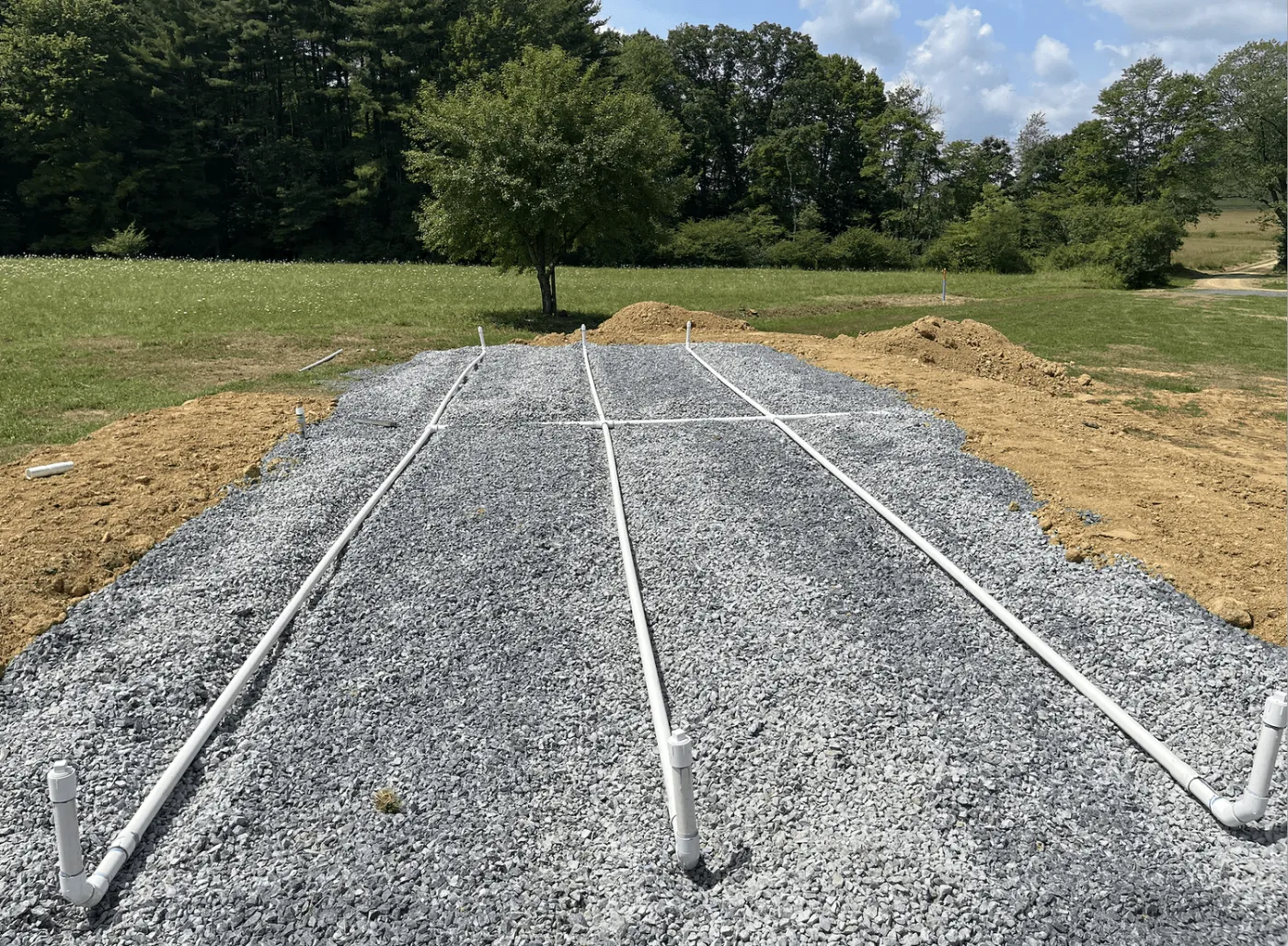
When the soil profile will not support a standard system, Pennsylvania DEP lists alternate designs. The sand mound is the common one in this area. It is an absorption area built in clean sand fill above the natural ground, usually fed by a pump.
Penn State Extension says the same thing in soil terms. In-ground gravity absorption areas work where water moves through the soil at roughly 6 to 60 minutes per inch. Sites outside that range need a more complex design, such as a sand mound.
That is where the extra money goes. A mound means hauled sand, a bigger footprint, a pump with controls, and more grading at the end.
What do the permit and the soil testing add?
In Pennsylvania the septic permit runs through the township or borough sewage enforcement officer. The authority is the state Sewage Facilities Act, known as Act 537. That officer also does the soil work that decides your system type.
Two tests set the design. The first is a deep probe, and Pennsylvania DEP describes it as a backhoe pit dug as deep as eight feet so the officer can read the soil profile. The second is a percolation test, which uses at least six holes in the proposed absorption area to measure how fast water drains.
DEP also says the officer approves or denies a completed application within seven days, then inspects the finished system before it is covered. Published guides put soil testing and site evaluation at about $500 to $1,200, and permit and design fees at about $300 to $800. Fees are set locally, so ask your township office for its current schedule.
Offices run differently town to town. Dingman Township in Pike County, for one, has a state certified sewage enforcement officer with weekday morning office hours, and it asks for inspection requests in person rather than by email. Plan your schedule around that.
Is a septic replacement cheaper than a brand new system?
Usually not by much, and sometimes it costs more. A replacement gets priced like a new install because it is one: new tank, new distribution box, new absorption area, all built to a fresh approved design.
Replacements also carry work that a bare lot does not. The old tank has to be pumped and then removed or crushed and filled. The new absorption area often has to sit somewhere else on the lot, which can mean clearing and longer lines. A lawn, a deck or plantings in the way add restoration at the end.
The other side of that is repair. If the tank is sound and the absorption area still takes water, it is often cheaper to repair the failed part first. A collapsed distribution box or a crushed line is a much smaller job than a whole new system.
What else moves the price on a Pike County lot?
Rock is the big one. When ledge shows up in the tank hole or the trench line, the excavation work slows down and machine time goes up. Ledge also limits where the system is allowed to sit.
Access matters. A long, steep or narrow route to the system area means more trips with sand and stone. Lake community lots are often tight, with wells, property lines and setbacks boxing in the usable area.
Size and site work fill in the rest. Tank size follows bedroom count, and DEP’s Act 537 fact sheet says a 900 gallon tank is used for a home with three bedrooms or fewer. Trees over the absorption area have to come out, and the finish grading has to shed water away from the system.
How do New Jersey and New York septic permits differ?
Across the bridges the paperwork changes, and so does who signs off. In New Jersey, systems at or under 2,000 gallons a day fall under state rule N.J.A.C. 7:9A. The permit comes from the local board of health, and the soil logs, plans and design data have to be signed and sealed by a septic system designer.
New York runs on Appendix 75-A of the state sanitary code, which covers residential systems under 1,000 gallons a day. County and local health departments evaluate the site, approve the design and inspect the finished system. Appendix 75-A wants at least four feet of usable soil over bedrock or clay for a standard absorption field, which is why raised and mound systems show up on the New York side too.
The cost difference shows up in design. Pennsylvania leans on the township sewage enforcement officer for the testing and the permit. New Jersey requires a septic system designer’s seal, and that seal is its own line on your budget.
What should you do first?
Start with the soil, because the soil sets the price. Until the deep probe and the percolation test are done, every number is an estimate, including the ranges on this page.
We dig the test pits for the sewage enforcement officer, then install to the approved design: tank, distribution box, absorption area and the final grading. If you are planning septic system installation in Milford or the towns nearby, call or text (973) 552-8580 for a free estimate.